
car accidents
What Should I Do After a Car Accident in California?
PUBLISHED JUNE 2, 2026 · UPDATED JULY 13, 2026 · CAR ACCIDENTS
Direct answer
What Should I Do After a Car Accident in California?
After a California car accident, check for injuries and call 911 in an emergency, move to a safe spot if you can, exchange information with the other driver, document the scene, get medical care promptly, and notify your own insurer. Legal deadlines exist and can be short, so consider speaking with an attorney before making final decisions.
Check for injuries and call 911 in an emergency
The first minutes after a crash are about safety, not paperwork. Check yourself and your passengers, and if anyone may be hurt, call 911. Emergency dispatchers are trained for exactly this moment and can guide you until responders arrive. Even if injuries seem minor, letting emergency personnel evaluate people at the scene creates a record of how everyone was doing right after the crash. Do not feel pressure to sort out fault or insurance while someone may need care. Everything else on this list can wait until people are safe.
Move to a safe location if you can
If the vehicles are drivable and no one appears seriously hurt, California drivers are generally expected to move out of travel lanes when it is safe to do so. Turn on hazard lights, and if you have flares or reflective triangles, use them. Secondary collisions, where another car strikes a stopped vehicle or a person standing in the roadway, are a real danger after any crash. If a vehicle cannot be moved or you are unsure, stay buckled inside with hazards on or stand well away from traffic while you wait for help.
Exchange information and document the scene
Exchange names, phone numbers, driver license numbers, license plates, and insurance details with every driver involved. If it is safe, photograph the vehicles, their positions, the road, traffic signs, skid marks, debris, and any visible injuries. Ask witnesses for their names and numbers before they leave, because they can be very hard to find later. If police respond, ask how to get a copy of the report. A fuller list of what to gather is at /evidence-checklist, and none of it requires special equipment beyond your phone.
Get medical care, even if you feel okay at first
Some accident symptoms take hours or days to appear, and adrenaline can mask pain in the moment. A prompt evaluation by a qualified medical professional does two things: it protects your health, and it creates a record connecting your condition to the crash. Tell the provider you were in an accident and describe every symptom, even ones that seem small. If severe symptoms develop at any point, treat it as an emergency and call 911 or go to an emergency room. This site cannot give medical advice; your providers can.
Report the crash where reporting is required
California has reporting requirements for certain crashes, including a DMV form for collisions involving injury or property damage above a set threshold, with its own time limit. There may also be a police report, and your insurance policy will have its own notice requirements. Rather than memorizing rules while recovering, check the current DMV guidance or ask an attorney which reports apply to your situation. Keeping copies of anything you file, along with confirmation numbers and dates, will make later steps easier.
Be thoughtful in early insurance conversations
Notify your own insurer of the crash as your policy requires, and be accurate and factual in what you report. With the other driver's insurance company, you can be polite while still taking your time; you are generally not required to give a recorded statement to another party's insurer, and many people consider speaking with an attorney before doing so. Never guess about fault, speed, or injuries, and never say your injuries are minor before a medical professional has evaluated you. Honest, careful communication protects you on every side.
Understand that legal deadlines exist
California sets time limits for taking legal action after an injury, and claims involving government entities, such as a city vehicle or a road-condition issue, can follow different procedures with shorter windows. The specific deadlines vary with the facts, and they are strict; missing one can end a claim regardless of how strong it is. You do not need to calculate any of this yourself. The practical takeaway is simply not to let a claim sit indefinitely, and to get your situation reviewed while records and memories are fresh.
When you are ready, start a case review
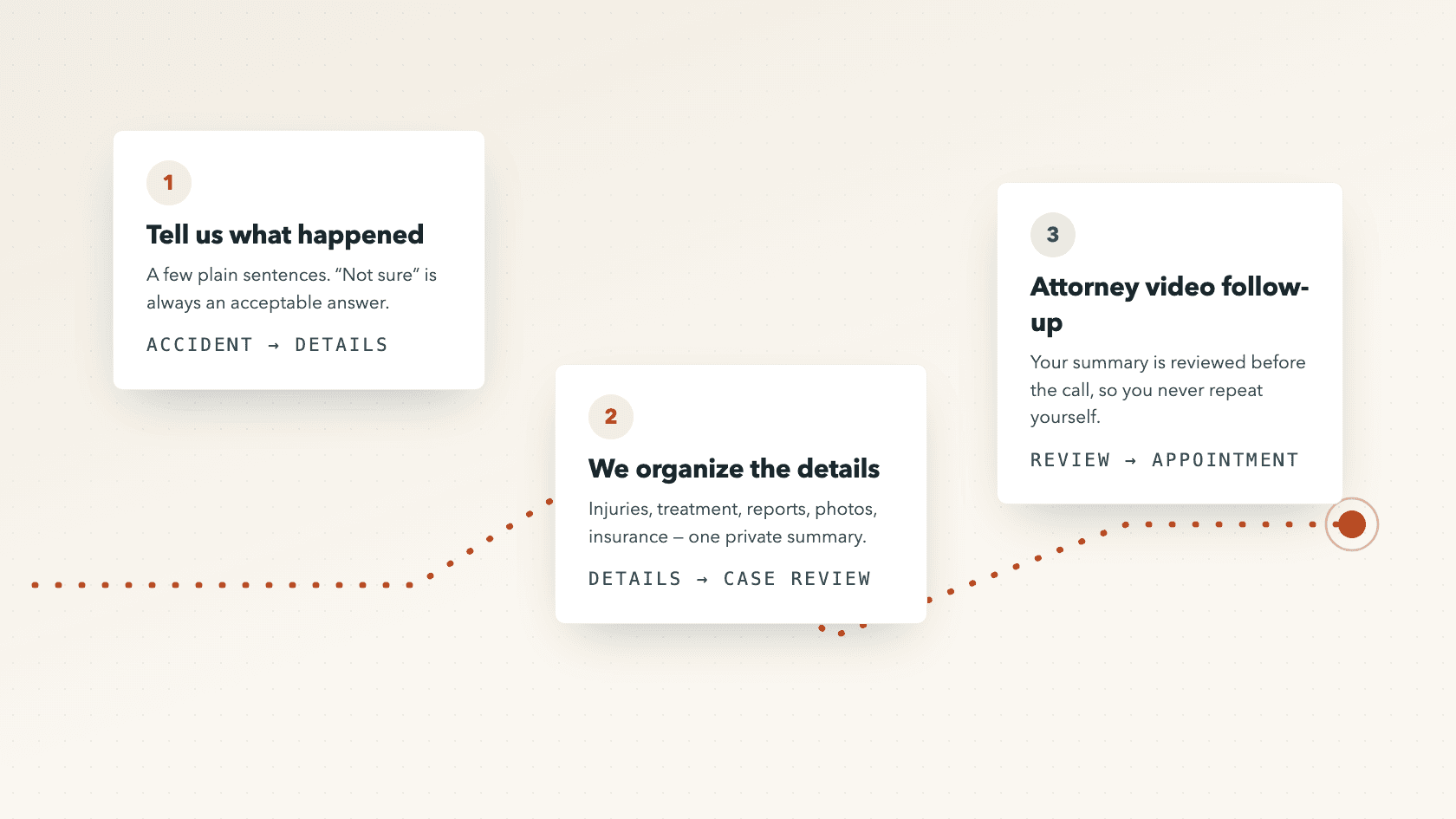
You do not have to decide anything today. When you want a clear next step, you can start a private case review at /case-review: you describe what happened in your own words, the details are organized for a California personal injury attorney, and video follow-up can be scheduled afterward. If your crash involved another vehicle, the information at /car-accident-lawyer explains how these claims generally work. This site provides legal information and attorney advertising, not legal advice, and there is no obligation after the review.
Common questions
Should I apologize at the scene?
Be courteous, but stick to facts. Statements at the scene can be repeated later in the claim process, and fault in California often turns on details no one fully knows in the first minutes. Checking on others and exchanging information does not require assigning blame.
What if the other driver has no insurance?
Your own policy may include uninsured or underinsured motorist coverage, which can apply in that situation. Review your policy documents, and consider speaking with an attorney about how an uninsured-driver claim typically proceeds in California.
When should I get my specific California injury situation reviewed?
Consider an attorney review when anyone was injured, symptoms are changing, fault or insurance coverage is disputed, several parties may be involved, important evidence may disappear, or you are unsure which legal deadline applies. A review should address your facts rather than relying only on general information.